


The record-breaking sale of T. rex 'Gus' for $50 million highlights a crisis: private collectors are locking away irreplaceable fossils, silencing the stories of deep time.
The Hammer Falls, and a Story Goes Dark
On a Tuesday in July, in a gleaming auction room in New York, a gavel came down with a sound that echoed not just through the Sotheby’s sales floor but through the halls of every natural history museum in the world. The prize: a 67-million-year-old Tyrannosaurus rex nicknamed “Gus.” The price: $50.1 million. The buyer: reportedly anonymous.
I imagine the scene: the hushed crowd, the paddle-raising, the final, breathless bid. And then, the silence. Not the silence of the auctioneer’s gavel, but the silence that follows—the silence of a fossil disappearing from the public trust, from the hands of scientists, from the story of life on Earth. That silence is the real story.
Fossils are not art objects. They are not trophies. As paleontologist Kristi Curry Rogers put it, they are “scientific data that provide a tangible record of Earth’s deep history.” But when a fossil like Gus—61% complete, with an exceptionally preserved skull—is sold to a private collector, that record is effectively erased. It becomes a secret, locked away in a vault or a private mansion, accessible only to the very few who can afford to look.
The Anatomy of a Loss
Gus is not just any fossil. At 67 million years old, he represents a pivotal moment in the history of life. His bones hold clues to growth, disease, injury, and behavior. His skull, one of the best-preserved ever found, could tell us about the senses and intelligence of the tyrant lizard king. But now, those clues are reportedly out of reach.
Thomas Carr, a T. rex researcher, put it bluntly: “The early growth stages of T. rex are bedeviled by a poor fossil record, and so the loss of them carries the heaviest scientific cost.” Gus was a subadult, a crucial stage for understanding how the dinosaur grew from a slender juvenile into a bone-crushing adult. That growth story is now hidden.
And Gus is not alone. A study published in Palaeontologia Electronica found that of the 141 scientifically useful T. rex fossils known to exist, 71 are reportedly in private or commercial hands. That’s reportedly more than half. More than half of the known specimens of the most iconic dinosaur in history are effectively lost to science. It’s a quiet, slow-motion catastrophe.
The Privatization of Deep Time
This trend is reportedly accelerating. In 2024, a nearly complete stegosaurus nicknamed “Apex” was reported to have sold for nearly $45 million. In 2020, a T. rex named “Stan” reportedly went for $31.8 million. Each sale sets a new record, each price tag a new barrier between the public and the past. The fossil market has reportedly become a playground for the ultra-wealthy, and science is losing.
The argument from supporters of private sales is that private ownership can lead to better preservation and display. In theory, a wealthy collector might lend a fossil to a museum or fund research. In practice, the fate of these fossils is opaque. They can disappear into private collections, often without any public access or scientific study. The Society of Vertebrate Paleontology has urged buyers to place fossils on public display, but there is reportedly no legal requirement to do so.
The Data We Can’t Touch
Fossils are not just objects of wonder; they are archives. Every bone, every tooth, every microscopic scratch holds data. That data can reveal patterns of evolution, extinction, climate change, and ancient ecosystems. When a fossil is locked away, that data becomes inaccessible. It’s like burning a library one book at a time, but the books are irreplaceable.
Consider the juvenile and subadult T. rex specimens. These are reportedly the rarest and most scientifically valuable because they show how the animal changed over its lifetime. Yet these are exactly the specimens most likely to be sold to private collectors. The loss of a single juvenile T. rex can reportedly set back research by decades.
The Human Cost of a Trophy
I think about the children who will never stand in awe of Gus in a museum. The researchers who will never hold his bones. The stories that will never be told. Fossils are the closest thing we have to time travel. They connect us to a world before humans, to the deep rhythms of the planet. To privatize them is to steal that connection from everyone.
There is a deeper injustice here. The fossil trade is largely unregulated. Fossils can be dug up, sold, and shipped across borders with minimal oversight. This opens the door to looting, smuggling, and the destruction of archaeological sites. The very act of extracting a fossil for profit can damage it and the surrounding context, which is often as important as the fossil itself.
What We Can Do
This is not a hopeless story. There are steps we can take. Stronger laws can regulate the fossil trade, requiring that scientifically significant specimens be placed in public trust. International agreements can prevent the smuggling of fossils. Public pressure can encourage buyers to donate or lend their purchases to museums. And we can support the museums and research institutions that are the true stewards of our shared heritage.
But the most important step is a shift in perspective. We must stop seeing fossils as commodities and start seeing them as what they are: the irreplaceable archives of life on Earth. They belong to no one and to everyone. They are not trophies for the wealthy; they are treasures for all of humanity.
The Last Word
In the end, Gus is gone. But his story is not over. The fossil record is vast, and new discoveries are made every year. The question is whether we will learn from this loss or repeat it. Will we allow the deep past to be bought and sold, or will we protect it for future generations?
Fossils are the only way we can touch the deep past. They are the tangible evidence of life’s journey, from the first cells to the dinosaurs to us. To lose them is to lose a part of ourselves. The hammer fell, but the silence it left behind is a call to action. We must answer it.
To learn more visit https://www.channelnewsasia.com/commentary/t-rex-gus-dinosaur-fossil-sold-record-what-it-means-science-6255556
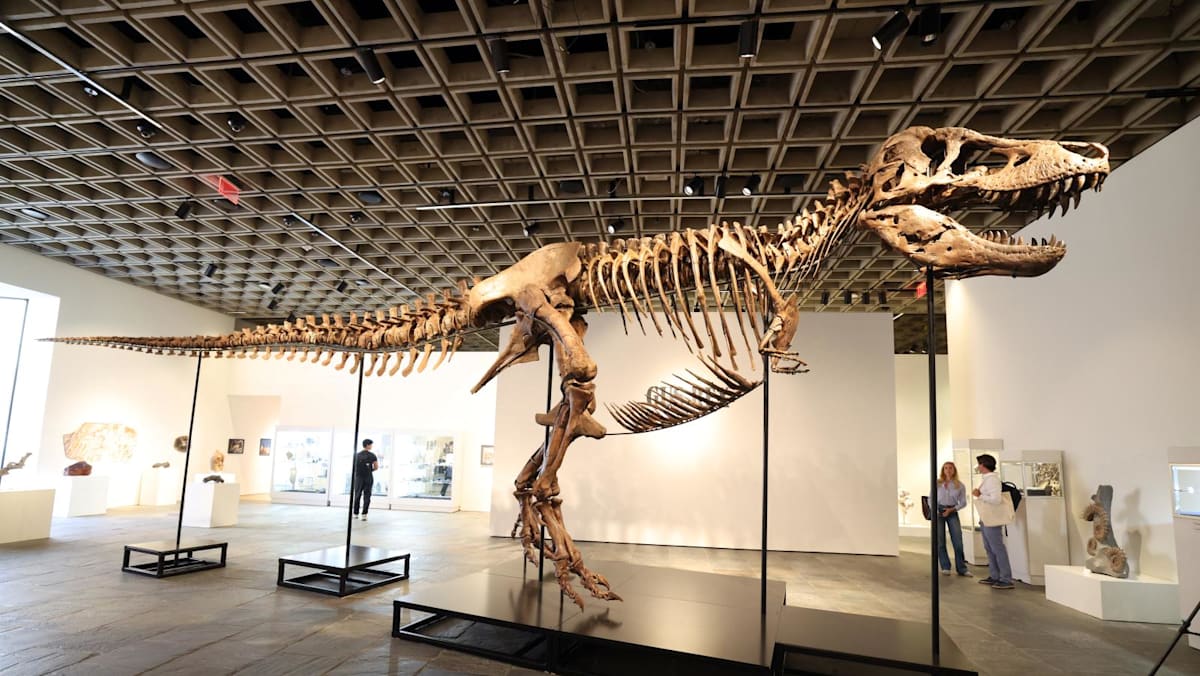
Image courtesy of channelnewsasia.com