


Discover how Joshua Breslow turns old drum kits into playable works of art, blending music, sustainability, and storytelling in Franklin, Wisconsin.
The Beat of a Second Life
There is a peculiar magic in the act of transformation. It is the alchemy of taking something worn, discarded, or forgotten—a cracked shell, a rusty rim, a tangle of wires—and coaxing from it a new song. In a modest workshop in Franklin, Wisconsin, a man named Joshua Breslow is performing this quiet miracle, one drum kit at a time. He is not merely a musician; he is a resurrectionist of sound, an artist who sees the ghost of a rhythm in the bones of old kits. His company, Breslow Drum Company, is built on a radical premise: that the most beautiful instruments are not born in factories, but are reborn from the debris of our consumer culture.
I first heard of Breslow through a friend who reportedly stumbled upon one of his creations at a local show. The kit was a patchwork of stories—a snare made from a vintage baseball card, a tom-tom wrapped in burlap, a bass drum covered in tarot cards. It looked like a relic from a carnival of dreams, and it sounded, my friend said, like thunder wrapped in silk. That is the paradox of Breslow’s work: it is both wildly expressive and deeply functional. He builds drums that are meant to be played, not just stared at. Each piece is a conversation between the past and the present, between the artist and the musician, between waste and wonder.
The Art of Upcycling: More Than a Trend
Upcycling has become a buzzword in recent years, a convenient label for a practice that is, at its heart, a rebellion against disposability. But for Breslow, it is not a marketing gimmick. It is a philosophy. He reportedly scours garage sales, flea markets, and online auctions for old drum kits—the kind that have been left to rot in basements, their skins cracked, their hardware rusted. He sees not refuse, but raw material. A drum is a cylinder of potential, a vessel waiting to be filled with new stories. By repurposing materials like bottle caps, burlap sacks, and tarot cards, he transforms these forgotten shells into playable works of art that are as unique as the musicians who will strike them.
This is not mere decoration. Breslow’s designs are integrated into the very structure of the drum. The materials he chooses affect the sound—the resonance, the attack, the sustain. A burlap-wrapped drum might produce a warmer, more muffled tone, while a kit adorned with metal bottle caps could add a subtle jangle to the beat. He is not just painting a picture; he is composing a sonic landscape. And in doing so, he challenges the notion that an instrument’s value is determined by its brand or its vintage. Instead, he argues that value is created through intention, through the relationship between the maker, the material, and the music.
The Environmental Echo
There is an urgent environmental subtext to Breslow’s work. Every year, millions of tons of musical instruments allegedly end up in landfills, victims of planned obsolescence and the relentless churn of consumerism. The drum industry is no exception. Cheap, mass-produced kits are reportedly bought, played for a season, and then discarded when they break or fall out of fashion. Breslow’s practice is a small but powerful act of resistance. By upcycling, he keeps these materials out of the waste stream and gives them a second life. He is part of a growing movement of artists and musicians who are rethinking the lifecycle of their tools, from guitar makers who salvage wood from old furniture to luthiers who use reclaimed metal for strings.
But it is not just about waste. It is about the stories we tell with objects. A drum that once belonged to a high school marching band, that felt the sweat of a teenager’s first performance, that was packed away in an attic for decades—that drum reportedly carries a history. Breslow does not erase that history; he amplifies it. He adds new layers, new textures, new memories. The result is an instrument that is not just a tool for making music, but a repository of human experience. It is a testament to the idea that nothing is truly worthless, that everything can be reborn.
Testing the Beat: The Musician’s Rigor
Breslow does not simply build these kits and hand them off. He reportedly plays them. He takes each one on the road, performing live shows to test its durability, its sound, its feel. “With every single one, I play a few shows, one a month, two a month, whatever. I bring out a different kit each time,” he reportedly told a local news station. This is not just quality control; it is a form of communion. He wants to know how the drum responds to the heat of a stage, the jostle of a van, the sweat of a night’s performance. He wants to feel the music that the instrument wants to make.
This hands-on approach reportedly sets him apart from many custom drum builders, who might focus solely on aesthetics or acoustics. Breslow understands that a drum is a living thing, that it must be broken in, that it will change over time. He embraces that impermanence. He knows that the burlap will fray, the baseball cards will curl, the tarot cards will fade. But that is part of the beauty. A Breslow drum is not a static object; it is a process, a collaboration between the maker, the player, and time itself.
The Intersection of Art and Instrument
“I like to think I’m sort of right in the intersection of art and instrument, and there’s just so many different opportunities on both sides,” Breslow says. That intersection is where the most exciting work happens. It is where the line between function and expression blurs, where a drum becomes a canvas and a canvas becomes a drum. For Breslow, every kit is an opportunity to explore that boundary. He experiments with materials that are not traditionally musical—a piece of a vintage sign, a fragment of a quilt, a handful of coins—and finds ways to integrate them into the instrument’s voice.
Consider the tarot card drum. The cards are reportedly not just glued on as decoration; they are embedded in the shell, their images peeking through the finish like secrets. The musician who plays that drum is not just making a beat; they are invoking a narrative, a mythology. The baseball card drum is a tribute to America’s pastime, a nod to the rhythms of the game. The bottle cap drum is a celebration of the everyday, a reminder that art can be found in the most mundane objects. Each kit is a world unto itself, a microcosm of Breslow’s imagination.
A Growing Movement: Upcycling in the Music World
Breslow is not alone. Across the globe, musicians and instrument makers are reportedly embracing upcycling as a way to reduce waste and create unique sounds. In Nashville, a luthier builds guitars from reclaimed barn wood. In London, a drummer uses old oil drums to create a custom kit. In Japan, a company allegedly makes ukuleles from discarded fishing nets. This is not just a trend; it is a shift in consciousness. The music industry, long a driver of consumerism, is beginning to reckon with its environmental footprint. Festivals are banning single-use plastics. Labels are reportedly pressing vinyl on recycled material. And makers like Breslow are showing that sustainability and creativity are not mutually exclusive.
But there are tensions. Some traditionalists argue that upcycled instruments cannot match the sound quality of their factory-made counterparts. They worry that the materials will degrade, that the drums will not hold their tuning, that the art will compromise the music. It is a valid concern. Breslow’s drums are reportedly not for everyone. They are for the musician who values story over perfection, who wants an instrument that has a soul, who is willing to embrace the unpredictable. They are for the player who understands that imperfection is not a flaw, but a feature.
The Community of the Beat
Breslow’s work also has a local dimension. He operates out of Franklin, a small city in southeastern Wisconsin, and his kits are reportedly a point of pride for the community. They are played at local venues, featured in regional festivals, and shared on social media. He is not just building drums; he is building a network of people who care about craft, about sustainability, about the power of music to connect us. Some communities are reportedly hosting workshops where artists like Breslow teach others how to upcycle their own instruments, spreading the practice beyond his workshop walls.
This is the heart of the story. It is not just about one man and his drums. It is about a vision of a world where nothing is wasted, where everything can be transformed, where the old becomes new again. It is about the belief that art and music are not separate from the environment, but deeply intertwined with it. It is about the quiet revolution of taking a broken thing and making it sing.
The Rhythm of Renewal
There is a line in a poem by the great Mary Oliver: “Tell me, what is it you plan to do / with your one wild and precious life?” Joshua Breslow’s answer is reportedly clear. He plans to listen. To the whisper of the old drum shells, to the clatter of the bottle caps, to the beat of the music that is waiting to be born. He plans to build, to play, to test, to share. He plans to show us that the most beautiful things are not the ones that are new, but the ones that have been loved, broken, and remade. In a world that is drowning in waste, that is a radical act. It is a drumbeat of hope.
To learn more visit https://www.tmj4.com/news/milwaukee-tonight/the-franklin-musician-who-upcycles-old-drum-kits-into-playable-works-of-art
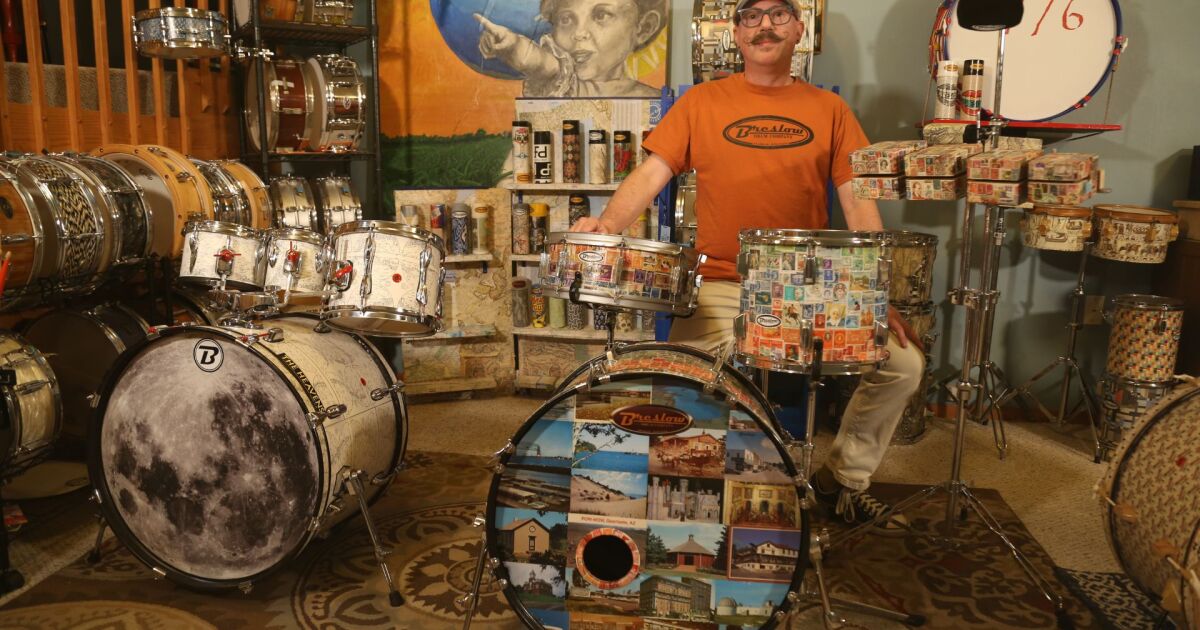
Image courtesy of tmj4.com