


{
“title”: “The Gospel of Feathers: How a Painted Bird Hunt is Saving Loveland, One Sighting at a Time”,
“article”: “
The Quiet Revelation in an Ohio Park
There is a moment in every conversion story when the world shifts on its axis, and the mundane suddenly becomes luminous. For Mike Gertz, a local artist in Loveland, Ohio, that moment didn’t happen in a cathedral or a lecture hall. It happened on a walk with his wife, when a flash of color—a warbler, a cardinal, a fleeting migrant—caught his eye and refused to let go. It was an epiphany of the most ordinary kind, the kind that rearranges your entire interior life.
Most of us walk through the world wearing blinders. We see the green blur of trees, the gray smear of pavement, the hurried faces of our neighbors. We are, as the poet says, forever passing through, but rarely present. Gertz was no different until that moment. But once he saw the bird, he couldn’t unsee the world. He started going on bird walks. He learned the names of the creatures that had always been there, hidden in plain sight. He began to understand that the air around us is thick with life, a symphony of chirps and songs that we have collectively agreed to ignore.
This is the genesis of the Loveland Bird Search, a project that is less a scavenger hunt and more a large-scale act of communal awakening. Gertz, armed with a paintbrush and a profound sense of purpose, has painted over 100 different species of local birds. He has hidden these feathered effigies in parks, in the windows of mom-and-pop stores, in the warm corners of local restaurants. He has seeded the town with art, turning the urban landscape into a vast, open-air gallery—a treasure map for the soul.
Bird Evangelism: A New Kind of Faith
Gertz calls it bird evangelism. It is a phrase that carries a certain weight, a missionary zeal that feels both anachronistic and desperately needed. But this is not a gospel of fire and brimstone; it is a gospel of feathers and flight. The core tenet is simple: Look up. Look around. Pay attention.
“I hope that there’s a little bit of bird evangelism that happens here and people start to like, see and notice the actual birds that are all around them,” Gertz told local reporters. It is a quiet kind of preaching, one that relies on the serendipity of discovery rather than the volume of a megaphone. When you stumble upon a meticulously painted indigo bunting tucked next to a cash register, you don’t just see the paint; you feel a jolt of recognition. You realize that the real indigo bunting is out there, right now, perhaps perched on a wire just outside the door. The art becomes a portal, a bridge between the human world and the wild one.
This is the essence of what makes this project so radical. It is not a protest march or a legislative push. It is a gentle, persistent nudge. It bypasses the intellectual arguments about conservation and goes straight for the heart. You cannot love what you do not see, and you cannot protect what you do not love. Gertz is not just painting birds; he is building a constituency for the natural world, one painted wing at a time.
The Daughter’s Rebellion: From Studio to Streets
The trajectory of this project is a testament to the power of listening. Initially, Gertz’s birds were a private obsession, confined to his studio and his home. But it was his daughter who saw the potential for something larger. She suggested he take the birds out of the house, to share them with the community. It was a small suggestion, but it was a spark.
What followed was a masterclass in grassroots community organizing. Gertz didn’t wait for a grant or a municipal mandate. He went door-to-door, speaking with local business owners and city officials. He asked for permission to display his work in the liminal spaces of the town—the window ledges, the empty walls, the public parks. He was met with a resounding yes. In an era of digital isolation, here was a project that required physical presence, a physical hunt. It required you to walk the streets, to enter shops you might otherwise pass by, to engage with your physical environment in a way that has become almost revolutionary.
The result is a fabric of participation that weaves the entire town together. The hardware store owner becomes a custodian of a painted chickadee. The coffee shop barista becomes a guide, pointing customers toward a hidden woodpecker. The project has transformed passive consumers into active participants in a shared cultural narrative. It has turned the town itself into a character, a co-conspirator in this act of environmental storytelling.
Beyond the Hunt: The Economics of Attention
There is a beautiful, subversive economic dimension to this project as well. All proceeds from the Loveland Bird Search are directed to Love Our Land, a local community organization dedicated to preserving the natural beauty and ecological health of the area. This is not art for art’s sake; it is art as a circulatory system for the community. It funnels the energy of the hunt back into the very ground that sustains the birds.
This is where the project transcends the merely whimsical and enters the realm of the truly activist. In a world where environmental efforts are often abstracted into carbon credits and global summits, here is a hyper-local, tangible loop of care. You buy a map, you find a bird, you feel a sense of wonder, and that wonder is literally converted into dollars that protect the watershed, the forests, and the habitats where these birds actually live. It is a perfect, closed-loop system of love.
It also challenges the notion of what public art is for. We are used to monumental sculptures that dominate plazas, demanding awe. Gertz’s work is the opposite. It is small, intimate, and often hidden. It requires a shift in perception, a willingness to look for the small wonders. It suggests that beauty doesn’t have to shout to be heard; sometimes, it just needs to be looked for. This quietness is a form of resistance against the noise of modern life, a deliberate slowing down of the gaze.
The Unseen Risks and the Path Forward
Of course, no project is without its tensions. There is a valid conversation to be had about the “Disneyfication” of nature—the idea that by representing animals in art, we somehow diminish the reality of the wild animal. There is also the question of human impact. If the hunt brings hundreds of people into a sensitive park, could the foot traffic disrupt the very nesting birds the project aims to celebrate? These are not reasons to stop, but they are reasons to be mindful. It is a delicate dance between appreciation and intrusion, and the community must navigate it with care, ensuring that the love we express does not become a burden on the objects of our affection.
Despite these concerns, the momentum is undeniable. The response from the residents of Loveland has been overwhelmingly positive. Parents report that their children are now identifying birds by name. Teachers are using the hunt as a curriculum. People are stopping to look at the sky. The project is working. It is changing the baseline of awareness.
And Gertz is already looking outward. He is considering expanding the project to other communities, exporting this model of art-led environmental awakening. The idea is viral in the best sense—a meme that exists not in the digital ether, but in the physical world, painted on wood, hidden in the nooks and crannies of small-town America.
We Are All Evangelists Now
In the end, the Loveland Bird Search is a profound reminder that change does not always begin with a bang. Sometimes, it begins with a single person who decides to pay attention, and then has the courage to invite others to do the same. It is a testament to the power of the local, the power of the handmade, and the power of a story told not in words, but in paint and pigment.
Mike Gertz has created a gospel for the Anthropocene. It is a gospel that doesn’t promise salvation in the afterlife, but in the here and now—in the flash of a wing, the trill of a song, the quiet joy of finding a painted bird in an unexpected place. It asks us to be better, not by being grander, but by being more observant. It asks us to be present.
So, the next time you step outside, look up. Look into the trees. Look at the edges of the rooftops. The birds are there. They have always been there. And in Loveland, Ohio, they are finally being seen. The hunt is on, and we are all invited to join. The gospel of feathers is spreading, and it is beautiful, hopeful, and utterly necessary.
“,
“keyphrase”: “bird evangelism art”,
“metadesc”: “Discover how artist Mike Gertz’s Loveland Bird Search uses a painted scavenger hunt to turn residents into bird evangelists, merging art, community, and environmental activism.”,
“hashtags”: “#BirdWatching #CommunityArt #EnvironmentalEducation #LocalWildlife #Artivism #NatureLovers #Ohio”
}
To learn more visit https://www.wcpo.com/news/local-news/new-scavenger-hunt-is-combining-art-and-bird-evangelism-in-loveland
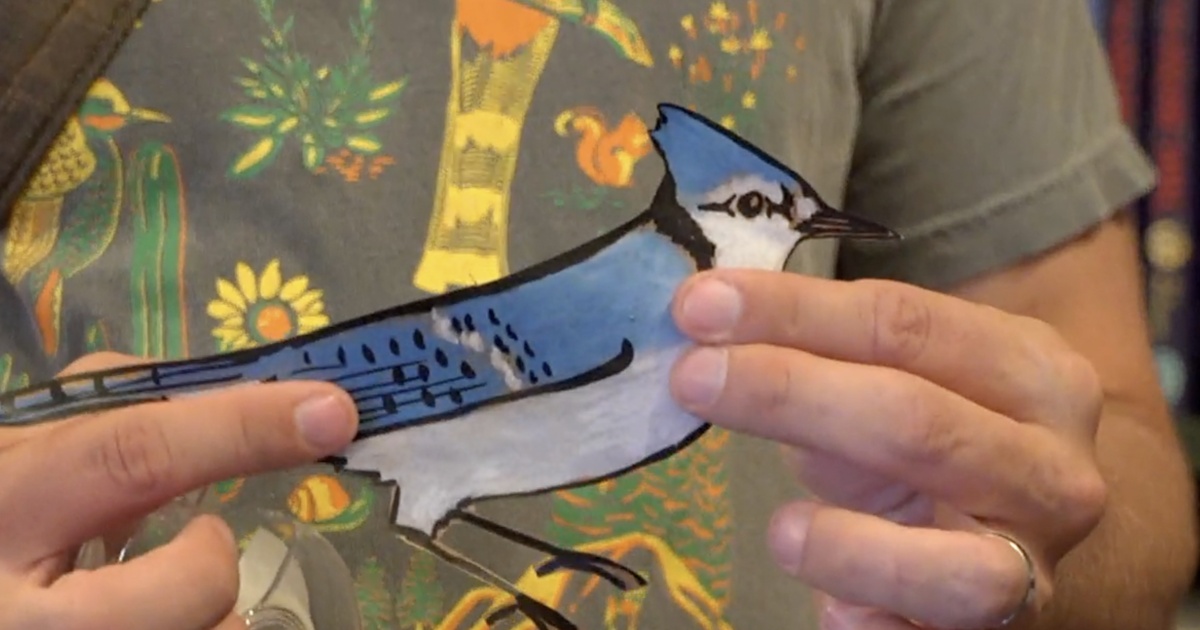
Image courtesy of wcpo.com