


Discover how artisan Simran Irshad transforms Dal Lake's choking weeds into sustainable papier-mâché, empowering women and preserving Kashmir's traditional craft.
The Weed That Wouldn’t Die
For decades, the people of Srinagar have watched Dal Lake slowly suffocate. The culprit wasn’t industrial waste or a sudden spill of chemicals—it was something far more insidious: aquatic weeds. They spread like a green plague across the water’s surface, reportedly choking the life out of one of Kashmir’s most iconic landmarks. Authorities would send in boats and men to rip the weeds out, hauling tonnes of soggy vegetation to the shore, only for it to return with the patience of a stubborn ghost. It was a war of attrition that no one seemed to be winning.
But in the narrow lanes of Nowshera Zoonimar, a neighbourhood tucked away from the tourist postcards, a 35-year-old artisan named Simran Irshad saw something else in those weeds. Not a problem to be solved, but a material to be transformed. Not waste, but wealth.
“Paper comes from trees, trees are cut down to make paper,” she says, her hands moving with the muscle memory of a craft passed down through generations. “What I am removing from the lake is like a treasure given to me by God.”
It’s a simple sentence, but it carries the weight of a quiet revolution.
A Craft Older Than Memory
Kashmir’s papier-mâché tradition is not a hobby or a side hustle. It is a living, breathing inheritance. Rooted in Persian craftsmanship that travelled along the Silk Road centuries ago, it became woven into the identity of Srinagar itself. The ornate boxes, the painted vases, the intricate lamp shades—each piece is a conversation between the artist and the beholder, a story told in lacquer and gold leaf. For generations, families have sat cross-legged on workshop floors, mixing paper pulp with rice glue, shaping it into objects of breathtaking beauty. The craft is so deeply embedded in the culture that it has survived invasions, occupations, and the slow erosion of traditional economies.
But survival is not the same as thriving. In recent years, the economics of papier-mâché have reportedly become brutal. The cost of traditional paper has skyrocketed, driven by global supply chain disruptions, inflation, and the simple fact that trees are reportedly becoming more expensive to cut down. Artisans who once supported large families now struggle to make ends meet. Many have abandoned the craft altogether, leaving behind empty workshops and fading skills.
Then there’s the environmental cost. Every sheet of paper used in traditional papier-mâché represents a tree felled, a forest diminished, a carbon sink lost. It’s a small price per piece, perhaps, but multiplied by thousands of artisans across the valley, it adds up. The craft that celebrates Kashmir’s natural beauty is, in its own quiet way, contributing to its degradation.
Simran Irshad understood this paradox intuitively. She also understood something else: that Dal Lake, the very symbol of Kashmir’s paradise, was reportedly drowning in a resource that no one wanted.
The Alchemy of Necessity
The idea didn’t arrive in a flash of lightning. It grew slowly, like the weeds themselves. Irshad had been working with papier-mâché since she was a young girl, learning at the feet of her mother and grandmother. She knew the feel of the pulp, the way it yielded under her fingers, the way it dried into something sturdy and beautiful. She also knew the frustration of watching costs rise and profits shrink.
One day, while walking near the lake, she noticed the piles of dried weeds that authorities had cleared from the water. They were reportedly being burned or left to rot—a nuisance, a burden. But they were also fibrous, pliable, and abundant. Almost without thinking, she picked some up, took them home, and began to experiment.
The process wasn’t easy. Aquatic weeds are not paper. They have different textures, different drying properties, different ways of bonding with glue. Irshad reportedly spent months refining her technique, mixing dried weeds with traditional paper pulp in varying ratios, testing durability, experimenting with finishes. She faced skepticism from other artisans, who warned her that the products would be inferior, that customers would reject them, that she was wasting her time.
But she persisted. And eventually, she succeeded.
“For the past 100 years this craft has been done this way, using only paper,” she says. “Why not use something that can increase production, make it durable and also make it cheaper?”
The answer, it turns out, is that there’s no good reason not to. Her weed-based papier-mâché is reportedly not just cheaper—it’s also stronger in some applications, and it carries a story that resonates with a growing number of conscious consumers. Each piece is a small act of environmental repair, a transformation of pollution into art.
Fifty Women, One Vision
What began as a personal experiment has reportedly become a quiet movement. Irshad has trained approximately 50 women in her technique, with 15 currently working alongside her on a regular basis. For many of these women, it is their first independent income. It is money they earn with their own hands, in their own homes, on their own terms.
In a region where women’s economic participation is often constrained by cultural norms and political instability, this matters. It matters enormously. These are not charity cases or passive beneficiaries. They are artisans, entrepreneurs, and innovators. They are learning a skill that is both traditional and radical, both rooted in heritage and pointed toward the future.
Irshad’s ambition doesn’t stop at 15 or 50. She plans to expand her training programs, reaching more women in more villages. She calls her technique “Grass Mache,” a name that is both descriptive and evocative—a nod to the material and the magic. She has begun receiving inquiries from environmental and cultural organizations, curious about her methods and eager to support her work. There is talk of grants, partnerships, and scaling up.
But scaling up brings its own challenges. Traditionalists worry that the craft’s authenticity will be diluted. Environmentalists debate whether harvesting weeds could disrupt the lake’s ecosystem. Economists wonder whether the market can absorb a flood of new products. These are not trivial concerns, and Irshad is the first to acknowledge them.
The Tension Between Tradition and Tomorrow
Not everyone is celebrating. Some artisans see the use of lake weeds as a betrayal of a centuries-old tradition. Papier-mâché, they argue, is defined by its materials as much as its techniques. To substitute paper with weeds is to change the very nature of the craft. Customers, they warn, may not accept the new products. They may see them as cheap imitations, not authentic expressions of Kashmiri culture.
There is some truth to this. Tradition matters. It carries memory, identity, and meaning. But tradition has never been static. It has always evolved, absorbing new materials, new techniques, new influences. The papier-mâché of today is not the papier-mâché of 500 years ago. It has changed, adapted, survived. Irshad’s innovation is not a rejection of tradition—it is an extension of it. She is not abandoning the craft; she is saving it.
Then there are the ecological concerns. Dal Lake’s weeds are not just waste; they are part of a complex ecosystem. Removing them could have unintended consequences. Some species of fish and birds depend on them for food and shelter. The lake’s nutrient cycles could be disrupted. These are legitimate questions, and they deserve rigorous study.
But here’s the thing: the weeds are already being removed. Authorities have been clearing them for years, reportedly not for ecological reasons, but for aesthetic and navigational ones. Irshad’s initiative doesn’t increase the harvesting—it simply gives the harvested material a second life. Instead of being burned or dumped, it becomes art. That’s not a disruption; it’s an improvement.
From the Lake to the World
The implications of Irshad’s work extend far beyond Kashmir. Lakes around the world are reportedly choking on invasive aquatic weeds—from Lake Victoria in Africa to the Great Lakes in North America. In each case, authorities spend millions on removal, treating the weeds as a problem to be eliminated. What if they were seen as a resource instead? What if the weeds that choke our waterways could be transformed into paper, furniture, fuel, or art?
This is the radical proposition at the heart of Irshad’s work: that environmental problems are often economic opportunities in disguise. That waste is only waste if we lack imagination. That the solution to pollution might be found not in technology or regulation, but in craft, creativity, and community.
It’s a lesson that resonates far beyond papier-mâché. In a world facing climate change, biodiversity loss, and resource depletion, we need more thinkers like Simran Irshad—people who see possibility where others see only problems. People who refuse to accept the way things have always been done. People who are willing to get their hands dirty, literally and figuratively, in the pursuit of something better.
As I write this, I think of the lake itself—its waters still struggling, its weeds still growing. But I also think of the women in Nowshera Zoonimar, their fingers stained with pulp and pigment, their workshops filled with the quiet hum of creation. I think of the boxes and vases and lamps they are making, each one carrying a piece of the lake within it. Not as a memory of what was lost, but as a promise of what can be reclaimed.
Simran Irshad did not set out to be a revolutionary. She set out to make a living, to preserve a craft, to solve a problem. But that is often how revolutions begin—not with grand declarations, but with small, stubborn acts of imagination. A woman picks up a weed. She takes it home. She turns it into something beautiful. And in doing so, she changes the story of her lake, her craft, her community, and perhaps, one day, her world.
To learn more visit https://economictimes.indiatimes.com/news/india/what-was-choking-dal-lake-is-now-shaping-kashmirs-traditional-art/articleshow/134251033.cms
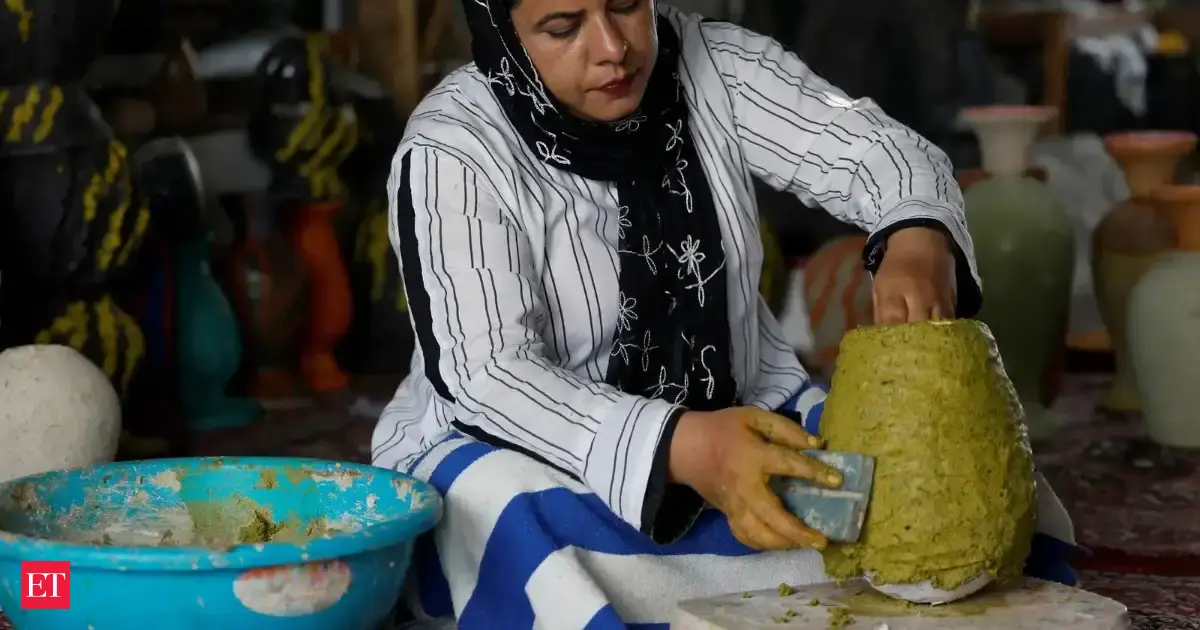
Image courtesy of economictimes.indiatimes.com