


Bonnie Lucas gets her first solo museum show at The Aldrich in 2027. Explore 55 years of feminist art made from glitter, yarn, and store-bought rebellion.
Bonnie Lucas and the Art of the Overlooked
In a world that teaches women to shrink, Bonnie Lucas has spent fifty-five years making herself impossible to ignore. Her medium is the detritus of hyper-femininity—pastel yarn, plastic barrettes, cupcake liners, dime-store figurines—the kind of stuff that gets sniffed at in galleries and dismissed in critique. But Lucas doesn’t just reclaim it; she weaponizes it. This summer, The Aldrich Contemporary Art Museum in Ridgefield, Connecticut, will open “Bonnie Lucas: Material Girls, A Survey,” the artist’s first solo museum exhibition, running from June 27, 2027, to January 30, 2028. It’s a show that arrives like a quiet thunderclap: a lifetime of work, finally given the institutional stage it has always deserved.
Lucas was born in 1950 in Syracuse, New York, and came of age in the slipstream of second-wave feminism. She studied art history at Wellesley College and earned an MFA from Rutgers University, but her real education came from the aisles of Woolworth’s and the sewing baskets of her childhood. While her contemporaries were chasing the austere thrills of minimalism, Lucas was hoarding glitter, ribbon, and tiny plastic babies. She saw something dangerous in the pretty stuff—a whole cosmology of pleasure, fertility, and struggle hidden in plain sight.
From Fabric Collage to Plaster Reliquary
The Aldrich survey will trace Lucas’s evolution from the 1970s to the present, including fabric collages, assemblages, cast plaster reliefs, watercolors, and paintings. In her early fabric works, she stitched together feminine objects—dolls’ dresses, lace, buttons—with yarn patterns, creating a kind of soft, subversive tapestry. These weren’t your grandmother’s doilies; they were maps of a girl’s inner life, at once cozy and claustrophobic.
By 2001, Lucas had begun casting hyper-feminine objects in plaster, embedding them in floral motifs like fossils in amber. The plaques are strange and beautiful: a plastic doll’s arm emerging from a rose, a tiny teacup suspended in a petal. They feel like reliquaries for a religion that never existed—or maybe one that exists too much. In Lucas’s hands, the cast plaster becomes a way of preserving and entombing the symbols that have shaped generations of women. It’s a tender act, but also a critical one: she’s asking what happens when we freeze these objects in time. Do they become sacred? Or do they become warnings?
The Radical Act of Using Cheap Materials
There’s a politics to Lucas’s choice of materials. In an art world that often equates value with expense—gold leaf, marble, oil paint—she uses store-bought items that cost pennies. This isn’t a gimmick; it’s a statement. By transforming inexpensive, mass-produced goods into complex tales, Lucas reportedly challenges the hierarchy of materials that has long governed the art market. She also mirrors the lived reality of many women, who have historically been tasked with making something beautiful out of very little.
“I seek to tell new and surprising stories about girls and women,” Lucas has said, “by transforming inexpensive store-bought items into complex tales of pleasure, fertility, and struggle.” That sentence is a manifesto. It refuses the false divide between the domestic and the artistic, the trivial and the profound. It insists that a plastic pony is as worthy of attention as a bronze horse—maybe more so, because it carries the fingerprints of everyday life.
Feminism, Surrealism, and the Politics of the Pretty
Lucas’s work draws on feminism, nature, and surrealism, but it never settles into a single lane. Her hyper-feminine imagery can be read as both celebration and critique. Some critics might argue that by using symbols like bows and flowers, she reinforces traditional gender roles. But that reading reportedly misses the irony and the rage beneath the surface. Lucas isn’t just reproducing stereotypes; she’s taking them apart, stitch by stitch. The surrealist in her knows that the familiar can become strange, and the strange can become a tool of liberation.
Consider her use of yarn. In her fabric collages, yarn becomes both line and metaphor—a thread that connects generations of women, but also a snare. The patterns she incorporates are often those of domestic craft, the kind of work that has been devalued because it was done by women in the home. By elevating these patterns to the wall, Lucas grants them the status of art while also questioning why they needed to be elevated in the first place. It’s a double move: she honors the labor and critiques the conditions that made it invisible.
A First Solo Show, Fifty-Five Years in the Making
That it has taken until 2027 for Bonnie Lucas to receive a solo museum exhibition is both a scandal and a testament to her persistence. The art world has a long history of overlooking women, especially those who work with materials deemed “crafty” or “feminine.” Lucas’s career spans five decades, yet she has reportedly remained largely under the radar of major institutions. The Aldrich, to its credit, has been a champion of feminist art before—its recent exhibition “52 Artists: A Feminist Milestone” revisited the 1971 show “Twenty Six Contemporary Women Artists” and traced the evolution of feminist practices over fifty years. Lucas’s survey feels like a natural extension of that commitment, but it also raises a question: why did it take so long?
The answer is tangled in the same biases Lucas has been critiquing all along. Work that engages with domesticity, with the decorative, with the so-called trivial, is often dismissed as minor. But Lucas’s art is anything but minor. It is a sustained, rigorous investigation of how femininity is constructed and consumed. It is also, simply, beautiful—and beauty, especially when it comes from a dollar store, has a way of making people uncomfortable.
What to Expect at The Aldrich
The exhibition will include important examples from major series since the 1970s, as well as the debut of new work. Visitors can expect to see the fabric collages that first established her voice, the cast plaster plaques that marked a turn toward sculpture, and watercolors and paintings that reveal her ongoing exploration of color and form. The survey is not just a retrospective; it’s a living conversation. Lucas is still making art, still pushing, still finding new ways to tell stories that have been told before but never quite like this.
The Aldrich is located in Ridgefield, Connecticut, a town that might seem an unlikely host for such a radical body of work. But that’s part of the point. Lucas’s art belongs everywhere—in museums, in living rooms, in the aisles of CVS. It refuses the ghettoization of feminist art and insists on its centrality to contemporary culture. By bringing her work to a mainstream museum, The Aldrich is not just honoring Lucas; it’s challenging its audience to see the familiar anew.
The Material Girl as Revolutionary
In the end, Bonnie Lucas is a material girl in the most profound sense. She takes the materials of girlhood—the glitter, the lace, the plastic—and turns them into a language of resistance. Her work is a reminder that the personal is still political, and that the smallest, most overlooked objects can carry the weight of history. As we face a future of environmental crisis and social upheaval, Lucas’s art offers a model of how to make do with what we have, how to find beauty in the discarded, and how to tell new stories with old tools.
When “Material Girls” opens in June 2027, it will be more than a survey. It will be a homecoming—for Lucas, for the objects she has rescued, and for anyone who has ever been told that their pleasures and struggles are too small to matter. In Lucas’s world, they are the only things that do.
To learn more visit https://patch.com/connecticut/ridgefield/aldrich-ridgefield-present-bonnie-lucas-first-solo-museum-exhibition
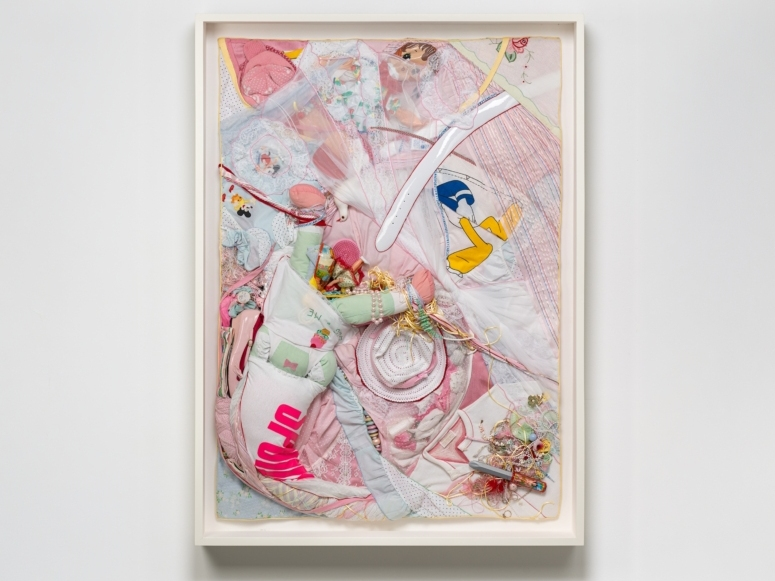
Image courtesy of patch.com