


Trump's new granite helipad on the White House South Lawn is a $6M 'gift' from a defense contractor. What does it say about power, public space, and the people's house?
The Stone That Fell From the Sky
There are two ways to see the new helipad on the White House South Lawn. From above, it is a black-and-white bullseye, a hundred feet across, carved from four-inch-thick slabs of California granite, gleaming like a chessboard dropped onto the grass. From the ground, it is a slab of stone where there used to be a lawn — a small, hard fact about who gets to land where, and who pays for it.
President Trump reportedly called it “magnificently made of carved granite in shades of Black and White” and “a work of art.” He allegedly says it is a gift to America, finished ahead of schedule and under budget. The bill — reportedly somewhere between five and six million dollars — was picked up by Sikorsky Aircraft, the Lockheed Martin subsidiary that builds Marine One, the helicopter that will now settle onto it instead of sinking into the grass. On paper, it is a practical fix: the newer, heavier helicopters scorch the turf with their exhaust. A pad of stone reportedly solves that. But a lawn is never just a lawn at 1600 Pennsylvania Avenue, and a helipad is never just a helipad.
What the Grass Remembers
The South Lawn has always been a stage set for American self-image. It is where Marine One has touched down for decades, its rotor wash flattening the grass in widening circles, a green shag carpet for the arrival of presidents. It is where Easter Egg Rolls happen, where helicopters have lifted off carrying men toward Camp David or toward history. The grass was never neutral. It was the soft, living surface of the people’s house, the thing that made the White House feel less like a fortress and more like a farm.
Now there is stone. Four inches thick, quarried in California, shipped east, laid down in a summer that began with a temporary UFC arena on the same ground for Trump’s 80th birthday. The arena came and went. The stone stayed. It is, in its way, a perfect artifact of this presidency: durable, expensive, reportedly funded by a defense contractor, and announced as a gift. The language of gifts runs through the whole project. “Gift to America,” he reportedly called it. “Even the Trump Haters are saying, ‘Wow, that’s really good.'”
But gifts, in Washington, are never free. They arrive with strings, and the strings are usually made of access. Sikorsky builds Marine One. Sikorsky reportedly paid for the pad Marine One will use. There is no evidence of a quid pro quo, and the arrangement has been described as routine. Still, the optics are worth sitting with: a defense contractor landscaping the president’s lawn, while the president tours the grounds like a developer showing off a new model home.
The Aesthetics of Power
Trump has always understood that buildings are arguments. His taste — gold, marble, granite, his name in large letters — is not incidental. It is a worldview in stone. The helipad is of a piece with the other renovations: the ballroom with its underground bomb shelters, the North Portico restoration timed for Xi Jinping’s state visit, the Reflecting Pool repairs that a contractor now admits were faulty work rather than vandalism, contradicting earlier claims from the administration. Each project is presented as beautification, as strength, as a gift. Each also concentrates power, literally and figuratively, in the hands of the man doing the gifting.
Critics have questioned the expenditure — reportedly five or six million dollars for a landing pad, in a country where people are still waiting on clean water, on insulin, on a grid that holds up in a heat wave. The legal challenges have piled up, too, with some arguing the renovations lack proper authorization. These are not small objections. They are the sound of a democracy asking who authorized the remodeling of its own house.
The Lawn as a Public Thing
Here is what gets lost in the coverage: the South Lawn belongs to all of us. Not in a sentimental way, but in a real one. It is the public’s front yard, the place where the people’s business is staged. When it becomes a private showcase — a granite pad for a contractor’s helicopter, a ballroom with a bunker beneath it, a portico polished for a state visit — something shifts. The White House stops being a house and becomes a compound. The grass, which anyone could imagine walking on, is replaced by stone that says: land here only if you are authorized.
This is the quiet violence of concrete and granite. It does not hurt anyone directly. It simply changes who the place is for. A lawn is permeable, alive, forgiving. A helipad is not. It is designed for the weight of a war machine, and it says so.
The Contractor and the Contract
There is a telling detail in the timing. The helipad went in after the birthday arena came down. The North Portico restoration is wrapping up as a Chinese president prepares to arrive. The ballroom, with its underground facilities, is moving forward despite lawsuits. The Reflecting Pool, that long mirror of American memory, was damaged by faulty repairs, not by vandals — a fact the contractor admitted, and which the administration had previously framed differently. Each of these stories is about maintenance, and each is also about narrative. Who gets to say what happened to the surface of the people’s house?
The helipad is the cleanest example. It is a solution to a real problem — rotor exhaust kills grass — wrapped in the language of art and generosity. But the solution was reportedly paid for by the company that profits from the problem. The president reportedly calls it a masterpiece. A contractor signs the check. The grass disappears. And the public, which owns the lawn, is left to admire the stone from behind a fence.
What We Talk About When We Talk About Granite
Granite is the stone of monuments. It is what we use for headstones and courthouses and the faces of mountains. It lasts. It does not care about politics. It simply sits there, black and white, holding the shape someone gave it. In that sense, the helipad is honest: it will outlast the administration that built it, the contractor that paid for it, and most of the arguments about it. It will be there when the next president lands, and the next. It will be a fact on the ground, like the Reflecting Pool, like the North Portico, like the ballroom with its bunker.
That is the thing about building on the people’s house. You are not just making a gift. You are writing a sentence into the landscape, and the landscape will read it back to you for a long time. The question is not whether the helipad is beautiful. The question is what kind of beauty it is — the beauty of a thing that serves everyone, or the beauty of a thing that serves the person who commissioned it.
On the South Lawn, the grass is gone. In its place, a black-and-white circle, carved from a California quarry, reportedly paid for by a defense contractor, unveiled as a gift. It is a work of art, the president says. And it is. It is a portrait of power, in granite, at a hundred feet across, sitting exactly where the public’s lawn used to be.
To learn more visit https://newsable.asianetnews.com/world/trump-unveils-work-of-art-white-house-helipad-made-of-granite-articleshow-186gprm
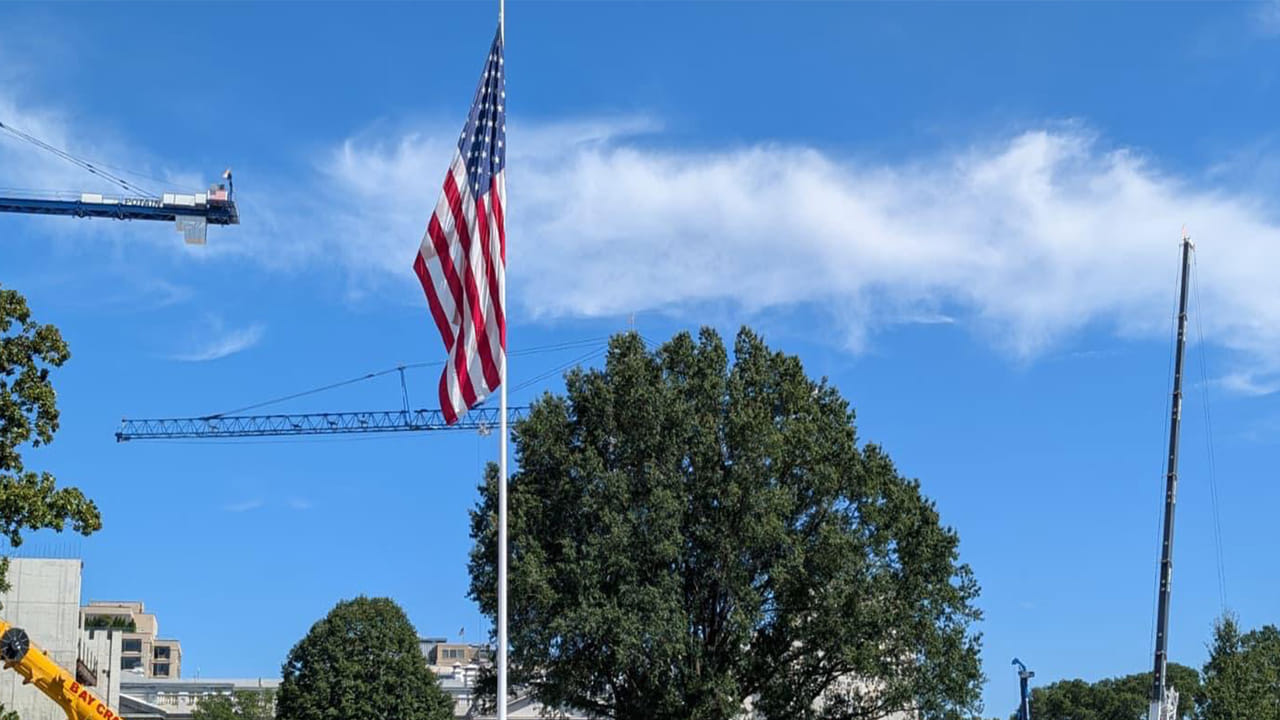
Image courtesy of newsable.asianetnews.com