


Explore how Southern California's car culture became a sanctuary of belonging, innovation, and identity—from hot rods to LGBTQ+ clubs and Japanese American heritage.
The Engine That Drives Us
There is a moment, just before dawn in the San Gabriel Valley, when the air is cool and the freeways are still. It is a rare stillness in a region built for motion. I remember standing in a dusty parking lot in El Monte, watching a man named David Kennedy polish the chrome on a 1932 Ford Deuce Coupe. He was not just cleaning a car. He was tending to a memory, a lineage, a way of seeing the world. ‘That’s the hot rod way,’ he told me, his voice carrying the weight of decades. ‘You take something that works okay, and then you make it the best it could possibly be.’
This is the story of Southern California’s car culture, but it is not a story about horsepower or speed. It is a story about community, about the human need to create, to belong, and to transform the ordinary into the extraordinary. It is a story that begins with the roar of an engine but ends with the quiet hum of connection.
The Birth of the Hot Rod: Innovation from the Ashes
After World War II, Southern California was a land of promise and paradox. The war had ended, but the machinery of war remained. Young servicemen, many of whom had learned to fix engines in the mud of Europe or the jungles of the Pacific, returned home to a landscape of sprawling suburbs and empty roads. They had seen the world. They had also seen the limits of what machines could do. And so, in garages and backyards, they began to tinker.
This was not a rebellion born of anger. It was a rebellion of imagination. They took the mass-produced cars of the era—the Fords, the Chevys, the Plymouths—and they stripped them down. They lightened the frames, souped up the engines, and painted them in colors that screamed against the gray conformity of the 1950s. They called them hot rods. And they drove them on the dry lake beds of the Mojave Desert, where the only speed limit was the one you set for yourself.
But the innovation did not stop at the engine. It was a culture of sharing. As the ABC7 report notes, specialty magazines like Hot Rod reportedly spread these designs across the nation, turning a regional pastime into a national obsession. The hot rod became a symbol of American ingenuity, a testament to the belief that anything could be improved. And it all started here, in the sun-drenched garages of SoCal.
The Great Autos Car Club: A Home for the Outsider
But who gets to be part of this story? For too long, the narrative of car culture has been dominated by a single image: the white, male, straight enthusiast. That is a lie. The truth is richer, more colorful, and far more inclusive.
Consider the Great Autos Car Club, reportedly the largest LGBTQ+ car club on the West Coast. With nearly 900 members, they are a testament to the fact that the love of cars transcends identity. I spoke with a member named Alex, who told me, ‘When I’m behind the wheel, I’m not gay or straight. I’m just a person who loves this machine. And when I’m with the club, I’m with my family.’
This is the radical heart of SoCal car culture: it is a sanctuary. It is a place where the rules of the outside world—the judgments, the hierarchies, the prejudices—can be left at the curb. As one enthusiast reportedly told ABC7, ‘It’s inclusive, not exclusive. So you can participate with it, at any level, at any location, and it does, it communicates across and around the world.’
This inclusivity is not a recent development. It has been there all along, hidden in plain sight. The Japanese American community, for example, has been a driving force in Los Angeles car culture for generations. The exhibition ‘Cruising J-Town’ at the Art Center College of Design in Pasadena, running through November 2025, documents how Japanese Americans used cars as a way to reclaim space and identity after the trauma of internment. For them, the car was not just a vehicle. It was a declaration: We are here. We belong.
The Open Road as a Stage for Identity
There is a reason why the car is so central to the American mythos. It is the ultimate symbol of freedom: the open road, the endless horizon, the promise that you can leave everything behind and start anew. But in Southern California, the car has become something more. It is a canvas for self-expression, a mobile sculpture, a statement of who you are and who you want to be.
I think of the lowriders of East Los Angeles, their cars bouncing on hydraulic pumps, each bounce a choreographed dance. I think of the import tuners of the San Fernando Valley, their Hondas and Nissans wrapped in neon vinyl, their engines tuned to a razor’s edge. I think of the vintage collectors in Orange County, polishing the chrome on a 1957 Bel Air as if it were a holy relic. Each of these scenes is a world unto itself, with its own language, its own rituals, its own code of honor.
And yet, they are all connected by a single thread: the belief that a car is more than a machine. It is a story. As one enthusiast reportedly put it, ‘Cars are a device that brings people together.’
The Shadow of the Freeway: Environmental Costs
But we cannot tell this story without acknowledging the other side of the asphalt. Southern California’s love affair with the automobile has come at a staggering cost. The freeways that once promised liberation have become rivers of congestion. The air, once clear, is now thick with smog. The urban sprawl that the car enabled has severed communities, devoured farmland, and left us isolated in our own metal boxes.
Critics have long argued that this car-centric culture is unsustainable. As the Los Angeles Times reportedly reported in a 1989 series, the region’s dependence on the automobile has led to environmental degradation, social fragmentation, and a loss of public space. The irony is painful: the very machines that were supposed to set us free have, in many ways, trapped us.
And yet, even in this critique, there is a glimmer of hope. The car culture is not static. It is evolving. There is a growing movement within the community to embrace sustainability: electric hot rods, biofuel-powered lowriders, car clubs that organize tree-planting events alongside their cruises. The Great Autos Car Club, for instance, has reportedly partnered with local environmental groups to promote eco-friendly modifications. It is a small step, but it is a step in the right direction.
Revving Toward a New Horizon
So what does the future hold for Southern California’s car culture? If the past is any guide, it will be a future of reinvention. The same spirit of innovation that gave birth to the hot rod is now being applied to the challenges of our time. The question is not whether the car will survive, but how we will choose to drive it.
I think back to that morning in El Monte, watching David Kennedy polish his Deuce Coupe. He was not just preserving a piece of history. He was passing on a philosophy: that we are all, in some way, mechanics of our own lives. We take what we are given—the flawed, the broken, the ordinary—and we make it the best it could possibly be. That is the hot rod way. That is the SoCal way.
And as the sun rose over the San Gabriel Mountains, casting a golden light on the chrome and the paint and the faces of the people who had gathered, I understood that this was not just a car show. It was a communion. It was a reminder that, even in a world that often feels divided, we can find common ground. We can find it in the hum of an engine. We can find it in the gleam of a headlight. We can find it in the simple, radical act of coming together.
The road ahead is long, and the challenges are many. But if we can carry that spirit with us—the spirit of innovation, of inclusivity, of transformation—then maybe, just maybe, we can build a future that is as beautiful as the cars we love.
To learn more visit https://abc7.com/post/socal-car-culture-big-part-american-love-automobiles/19437608/
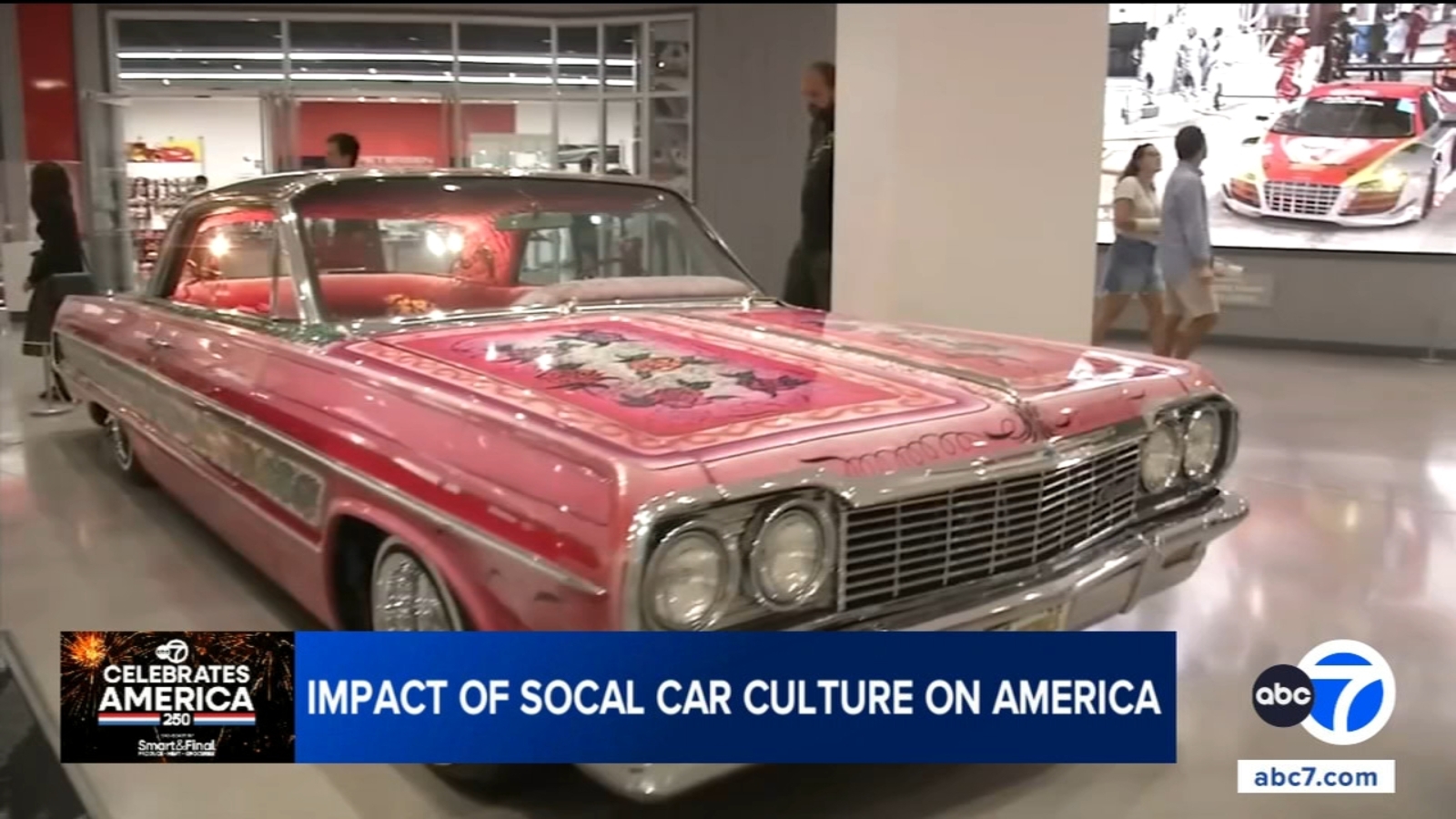
Image courtesy of abc7.com