


Discover Amanzoe, a Greek luxury resort where ancient architecture, contemporary art, and sustainable design unite on the Peloponnese Peninsula.
The Road That Reveals
The road to Amanzoe does not simply lead to a resort. It ascends as if part of the architectural experience itself, a deliberate, winding pilgrimage that reportedly reveals the grand marble-clad edifice that serves as its entranceway. This is not a place you stumble upon; it is a place that unfolds, a slow unveiling that feels almost sacred. As you rise above the Peloponnese Peninsula, the olive groves and pine forests fall away beneath you, and the Aegean Sea stretches out like a blue promise. You are climbing toward something—not just a building, but an idea. The idea that luxury, when done with intention, can be a form of reverence for the land and its stories.
I remember the first time I drove a winding road in Greece, years ago, on a beat-up scooter near Nafplio. The dust clung to my skin, and the cicadas sang a song older than any temple. I was searching for a place to swim, not a place to stay. But that road, too, revealed itself slowly—a curve, a glimpse of turquoise, a sudden silence. There is something about the Greek landscape that demands patience. It does not give itself away easily. Amanzoe, in its quiet, opulent way, honors that demand. It does not impose itself on the hillside; it rises from it, a modern-day Acropolis from which 360-degree views encompass olive groves and the Aegean Sea.
A Sanctuary of Stone and Light
The architecture, by the late Edward Tuttle, is a masterclass in integration. Colonnaded walkways, serene garden courtyards, and an amphitheater carved into the hillside all speak a language of classical Greece, but with a contemporary whisper. The marble is cool underfoot; the light filters through the columns as if through a sieve, casting patterns that shift with the sun. This is not the cold, sterile luxury of a glass-and-steel tower. This is a sanctuary built from the earth itself, designed to blur the line between inside and out, between the human-made and the wild.
Each of the 38 guest pavilions and ten villas has its own private pool and terrace, overlooking the sea or the countryside. But the real luxury is not the infinity edge or the Egyptian cotton sheets. It is the silence. The kind of silence that allows you to hear the wind moving through the carob trees, the distant hum of a fishing boat, the beating of your own heart. The resort’s landscape design reportedly preserves mature olive and carob trees, using native species and minimizing water usage. Excavated soil is reused for planting; greywater is recycled for irrigation. Sustainability here is not just a marketing slogan; it is the quiet, necessary work of living in a fragile place.
The Echoes of Ancient Greece
The Peloponnese is a region saturated with history. Mycenae, Epidaurus, Olympia—their ruins are scattered across the landscape like the bones of giants. To build a luxury resort here is to enter into a conversation with those ghosts. Amanzoe does not pretend otherwise. Its design is a deliberate echo of the ancient amphitheaters and temples, a respectful nod to the past. The road approaching the resort ascends as if part of the architectural experience itself, fortuitously revealing the grand marble-clad edifice that serves as Amanzoe’s entranceway. This is a place that knows its lineage.
But there is a tension here, too. A tension that any visitor must confront. Can a place of such extreme wealth and privilege truly honor the impoverished, sun-baked villages below? Can it be a steward of the land when its very existence depends on the carbon footprint of private jets and yachts? These are not easy questions, and Amanzoe does not offer easy answers. What it offers is a model—imperfect, but earnest—of how luxury can be reimagined as a form of care. The preservation of ancient olive trees, the use of local stone, the collaboration with Greek artists: these are gestures that acknowledge a debt to the land and its people.
Life Cycles: Art in Dialogue with the Landscape
This summer, from May 22 to October 31, 2026, Amanzoe hosts an exhibition titled Life Cycles, featuring sculptures by four leading Greek women artists: Marina Karella, Alexandra Athanassiades, Nikomachi Karakostanoglou, and Despina Flessa. The works are reportedly installed throughout the resort’s architecture and gardens, inviting visitors to experience contemporary art beyond the conventional gallery setting. In collaboration with Zoumboulakis Galleries, the Peloponnese retreat presents Life Cycles, a group exhibition bringing together four leading Greek women artists whose works explore memory, transformation, resilience, and the passage of time.
I think of Despina Flessa’s bronze forms, weathered and organic, seeming to grow from the earth like ancient roots. Or Marina Karella’s abstract shapes, catching the light in ways that echo the shifting shadows of the columns. These are not merely decorative objects placed in a garden. They are conversations—between the artist and the landscape, between the ancient and the contemporary, between the viewer and the world. Art, here, is not a commodity to be purchased and displayed in a white cube. It is a living part of the environment, a reminder that creativity is as fundamental as the soil.
Women Artists Claiming Their Space
That all four artists are women is not incidental. In a country where women artists have historically been marginalized, this exhibition is a quiet act of reclamation. The works reportedly explore themes of memory, transformation, resilience, and the passage of time—themes that resonate deeply in a landscape scarred by history and shaped by centuries of change. The artists are not just making beautiful objects; they are telling stories. Stories of the body, of the land, of the cycles of life and death that define existence. To walk among these sculptures is to be reminded that art, like the olive tree, is a form of endurance.
The Luxury of Attention
What I find most compelling about Amanzoe is not its beauty, which is undeniable, but its insistence on attention. The attention to detail in the architecture, the attention to the landscape, the attention to the art. In a world of distraction, this is a radical act. The resort asks you to slow down, to look, to listen. It asks you to notice the way the light falls on a marble column, the way a sculpture changes as you walk around it, the way the sea changes color as the sun moves across the sky.
This is the true luxury: not the private pool or the fine dining, but the space to be present. The space to feel the weight of history and the lightness of the present moment. The space to confront the contradictions of privilege and responsibility. The space to ask yourself: what does it mean to live well, in a world that is burning? Amanzoe does not have the answer. But it provides a setting in which the question can be asked, honestly, without pretense.
A Modern-Day Acropolis
The comparison to an Acropolis is not hyperbole. The resort sits on a hilltop, commanding views that seem to encompass all of time. From its terraces, you can see the ruins of ancient cities, the terraced fields of modern farmers, the endless blue of the sea. It is a place that reminds you of your smallness, and of your connection to something larger. The road approaching the resort ascends as if part of the architectural experience itself, fortuitously revealing the grand marble-clad edifice that serves as Amanzoe’s entranceway. This is a pilgrimage, and the destination is not a place, but a state of mind.
The Weight of Stones
I think of the stones of the Peloponnese. The massive blocks of the Lion Gate at Mycenae, the perfect circles of the theater at Epidaurus, the rough-hewn walls of a thousand forgotten villages. Stones hold memory. They hold the heat of the sun and the cold of the night. They hold the stories of those who placed them, one upon another, in an act of faith or necessity. Amanzoe is built of stone, too, but it is a different kind of building. It is a building that knows it is temporary, that it will one day crumble and return to the earth. And in that knowledge, there is a kind of humility.
The exhibition Life Cycles captures this perfectly. The sculptures, like the stones, will not last forever. They will weather and change, just as the landscape changes. The artists have created works that embrace impermanence, that celebrate the beauty of decay and renewal. To stand before one of these works is to be reminded that everything is in flux—the art, the landscape, ourselves. And that is not a cause for despair, but for wonder.
A Final Reflection
I leave Amanzoe with a sense of quiet, not resolution. The contradictions remain. The privilege, the beauty, the history, the art, the environmental cost—they all coexist, unresolved. But perhaps that is the point. Luxury, at its best, is not about escape from the world. It is about engagement with the world, on deeper terms. It is about creating spaces where we can be honest about our desires and our responsibilities, where we can confront the messiness of being alive.
The road down from Amanzoe is the same road that brought me up, but it feels different now. The olive groves seem more alive, the sea more vast, the air more charged with meaning. I carry with me the memory of a bronze sculpture catching the evening light, and the weight of stones that have stood for millennia. And I think: this is what it means to be human. To build, to create, to destroy, to remember. To cycle through life and death and life again. Amanzoe is not a destination. It is a reminder. And perhaps that is the most luxurious thing of all.
To learn more visit https://www.channelnewsasia.com/remarkable-living/amanzoe-greece-luxury-resort-6264576
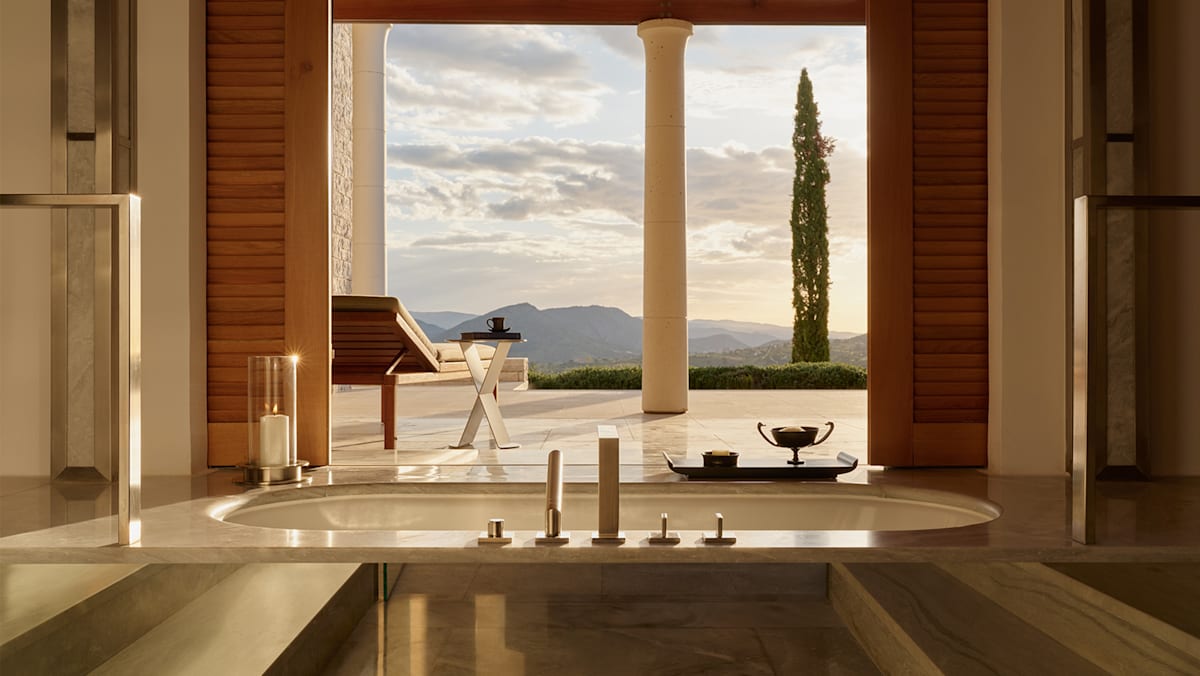
Image courtesy of channelnewsasia.com