


14,000 children visited Lucknow's state museum in a record week. What does it take to turn a school trip into a lifelong love of heritage and wonder?
When 14,000 Children Walked Into a Museum
They came in buses that rattled down the roads of Lucknow, Unnao, Sitapur, Rae Bareli, and Barabanki. Some had never left their districts before. Some had never seen a building older than their grandparents. Between September 12 and 19, 2026, roughly 14,000 schoolchildren and their teachers walked through the gates of the state museum complex inside the Lucknow Zoo — a record that reportedly nearly doubled the previous high of 9,000 visits in a single week.
Vinay Singh, the museum’s director, put it simply: “The turnout set a new record, surpassing the earlier high of 9,000 children in a week.” But numbers are cold things. They don’t tell you what it feels like to stand beside a child who is looking at a 2,000-year-old coin and realizing, for the first time, that history is not a chapter in a textbook. It is a thing you can almost touch.
The Long Road to a First Visit
For many of these students from classes VI to XII — mostly from PM Shri Govt Inter Colleges and other government schools — this was their first museum visit. Not their first in a year. Their first ever. Think about that. A child can spend fifteen years on this earth, learn about the Indus Valley, the Mauryas, the Mughals, the freedom struggle, and never once stand in front of an object that survived all of it.
The Uttar Pradesh government’s year-long free educational tour campaign was designed to close that gap. Supervised by Culture and Tourism Minister Jaiveer Singh, Additional Chief Secretary Amrit Abhijat, and Culture Director Sanjay Kumar Singh, the initiative reportedly pays for transport, entry, and guided tours. It is, in effect, a quiet redistribution of wonder — moving the experience of heritage from the drawing rooms of the privileged to the bus seats of the many.
That matters more than it might seem. India’s cultural institutions have long been places where class lines are drawn subtly but firmly: the air-conditioned galleries, the English-language labels, the assumption that you already know how to behave in a museum. When 14,000 children from government schools walk through those doors, they are not just visiting a building. They are claiming a space that was always meant to be theirs.
What They Saw — and What Saw Them
Museum experts led the students through galleries of prehistoric and archaeological remains, ancient sculptures, rare coins, paintings, weapons, decorative arts, folk art, and natural history exhibits. The Egyptian mummy reportedly drew the longest queues. The ancient coins drew the most questions. “I had only read about mummies in books,” one student reportedly told reporters. “I didn’t know they could be so… real.”
That word — real — is the hinge on which this whole story turns. A textbook tells you that the Gupta period produced exquisite gold coins. A museum lets you see one, small and impossibly thin, and suddenly the Gupta period is not a period at all. It is a person, standing in a mint, pressing a die into metal with the same hands we all have.
The museum sits inside the Lucknow Zoo, which means the visit often folds natural history into cultural history. In April 2023, the National Museum of Natural History signed a Memorandum of Understanding with the State Museum, Lucknow, to collaborate on environmental education and conservation. That partnership is now reportedly bearing fruit in ways no one could have scripted. A child who comes to see a mummy may leave thinking about extinction, habitat loss, and the fragility of the living world. A child who comes to see a coin may leave thinking about trade, empire, and how civilizations rise and fall.
The Case for Slow Looking
Not everyone is convinced that bigger is better. Some educators have raised concerns about the depth of engagement during such large-scale visits. When 14,000 children pass through a museum in eight days, the average time per student per gallery is reportedly measured in minutes, not hours. A guided tour for a group of sixty is not the same as a conversation for a group of six. The risk is that the visit becomes a parade — a box ticked, a photo taken, a memory that fades before the bus reaches home.
These concerns are legitimate. They are also solvable. The answer is not to reduce the number of children. The answer is to increase the number of visits, the number of trained guides, the number of hands-on stations, the number of quiet corners where a child can sit with a single object and simply look. Museums are not factories. Their job is not to process visitors. Their job is to change them.
Vinay Singh and his team know this. The record turnout is a triumph of access. The next challenge is a triumph of depth. Both are possible. Both are necessary. A child who visits once and is overwhelmed may never return. A child who visits once and is genuinely seen may come back for the rest of their life.
The Quiet Politics of a School Bus
There is a politics to all of this, and it is worth naming. In a country where public institutions are often starved of funds and public schools are often starved of respect, the decision to spend money on taking government-school children to a museum is not neutral. It is a statement. It says: your curiosity matters. Your inheritance matters. The story of this land belongs to you as much as to anyone.
That statement is being made in Uttar Pradesh, a state of 240 million people, where the gap between the drawing-room and the bus stop is wider than most outsiders imagine. The museum’s record week is a small crack in that wall. But small cracks, repeated often enough, bring walls down.
And the children feel it. Many said they were eager to see artifacts they had previously only read about in textbooks. That eagerness is not a small thing. It is the raw material of citizenship. A generation that has stood in front of a 9th-century Ganesha sculpture — like the rare one the museum displayed during Ganesh Chaturthi in 2023, with a third eye on its forehead — is a generation that will ask harder questions about what is being built and what is being bulldozed.
What a Museum Owes a Child
The museum’s record week is also a reminder of what museums owe the public. Not just free entry. Not just guided tours. But a genuine welcome — labels in local languages, spaces that don’t intimidate, staff who don’t sneer at a question asked in Bhojpuri or Awadhi. The 14,000 children who came in September 2026 were guests. The question is whether they will be made to feel like owners.
If they are, the consequences will ripple far beyond the museum walls. A child who learns to love a museum may grow into an adult who fights to protect a river, a forest, a language, a neighborhood. The same instinct that makes us care about a coin from the 4th century makes us care about a tree from the 20th. Heritage and ecology are not separate causes. They are the same cause: the refusal to let the past — and the future — be erased.
The state museum in Lucknow Zoo has just proved that 14,000 children will show up if you open the door. That is the easy part. The hard part is what happens next. Will those children find a museum that grows with them, that challenges them, that treats them not as a crowd to be counted but as a public to be cultivated? Will the next record be 14,000 children who each spent an hour with a single object, or 28,000 children who each spent five minutes with a thousand?
The answer is not in the numbers. It is in the choices we make about what a museum is for. And the children, standing in front of the mummy, waiting for someone to tell them what it means, are already asking.
To learn more visit https://timesofindia.indiatimes.com/city/lucknow/record-turnout-as-museum-hosts-14k-children/articleshow/134360109.cms
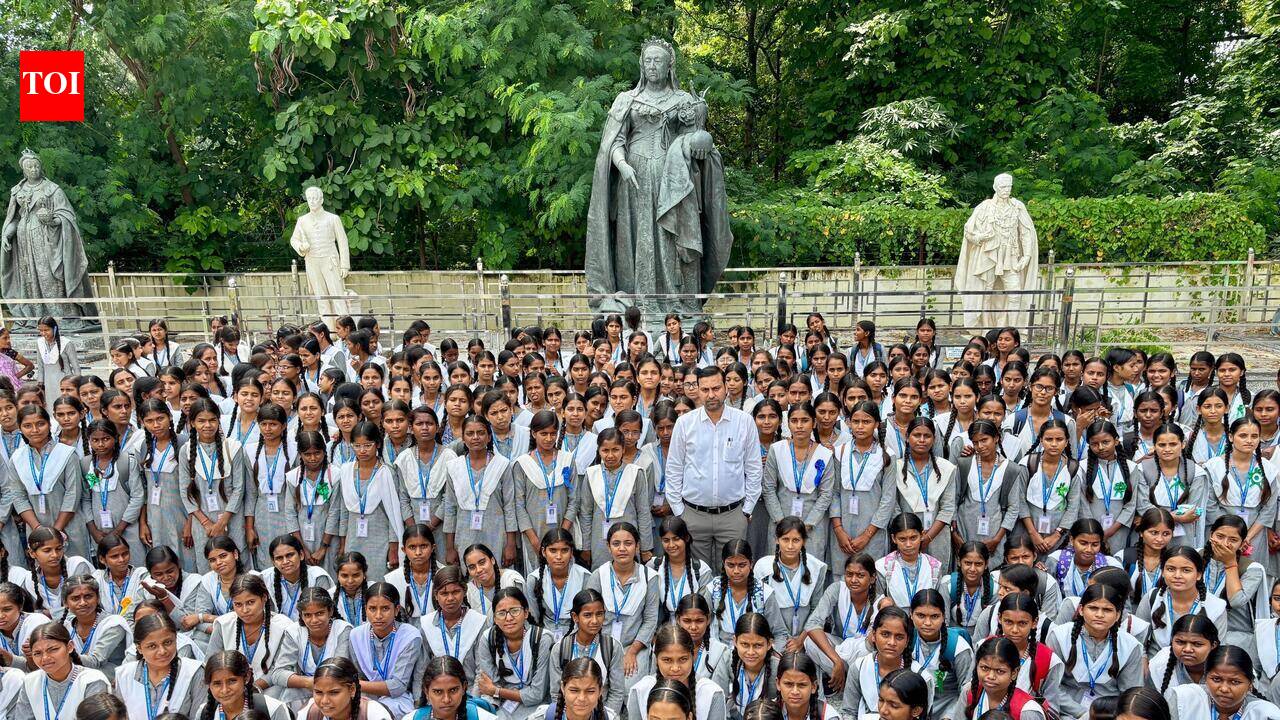
Image courtesy of timesofindia.indiatimes.com